Category Archives: Research Studies

Everyday Experiences and Communication

Researchers at Western University are interested in what people know about common events and how people communicate. They are looking for autistic and non-autistic adults and children to participate in an online study.

Who can participate?

  • Adults (18 and older) who are autistic or non-autistic
  • Children (aged 9-17) who are autistic or non-autistic, and their parents/guardians
  • Participants must be English speakers.

What is involved?

The study has three parts: 1. Filling out personality/behaviour questionnaires. (For children under 18, this would be completed by a parent or guardian.); 2. Completing a task about ordering the steps people do during common events (like going to the movies); 3. Having a Zoom call for language and knowledge tasks with the researcher.

Participants will answer questions about words, sentences, and pictures. A device with a reliable internet connection would be needed for the study. In total, the study may take up to 3 hours. Participants will be given $30 CAD for participating in the study. If you (or your child) want to participate or have questions, please email Kara Hannah at [email protected].

Research Study About ASD and Parenting

Are you the parent of a child with Autism Spectrum Disorder aged 13-45? Researchers at Vanderbilt University want to know more about you and your relationship with your child. This online study includes completing a consent form, two online questionnaires that will take about 30 minutes, and a short 10-minute recorded Zoom interview with a Vanderbilt student to find out more about you and your child. There is no payment but researchers will send study results when complete in a short feedback report.

For more information contact Elizabeth Roof at 615-343-3330 or [email protected].

Game-based cognitive intervention for children with Autism Spectrum Disorders

The University of Victoria Child Development Lab is currently conducting a study comparing game-based cognitive interventions for children with autism. The purpose of this research is to determine whether children can benefit from a cognitive intervention to improve their abilities to focus, remember, and self-regulate.

In this study, caregivers will have a role as their child’s interventionist and support their development of attention and executive functions through a parent-delivered intervention. Children will play one of two game-based interventions 3-to-4 times per week over 6 weeks with one of their caregivers supporting them. Each session will last approximately 30-45 minutes. Caregivers will receive training on how they can support their child in completing the sessions and the research team will be available to help you should questions arise. This research opportunity is currently open to children ages 4 to 8 years old who are diagnosed with Autism Spectrum Disorders (or who are waiting to get assessed for Autism Spectrum Disorders) and their caregivers.

For more information or to participate, contact Buse Bedir at [email protected].

Challenges and Facilitators During Transition to Adulthood of Adolescents with Developmental Disabilities

Researchers at Dalhousie University are conducting a project investigating challenges and resources during transition to adulthood of adolescents with disabilities. The purpose of this project is to uncover barriers and factors that ease the transition to adulthood of adolescents with disabilities from perspectives of youth with disabilities, their parents, and service providers. What we mean by services includes broad spectrum of resources including education, employment, healthcare services, etc. The goal of this study is to have a better understanding of services and resources that are available to support the process of transition to adulthood for young people living with disabilities.

Participation will require involvement in an interview either face to face or over phone or via Skype, whichever is convenient, to share ideas and perspectives. Participants will also be asked to answer some basic questions describing themselves through a confidential online survey platform or filling out paper-based demographic survey. Participation in this study is completely voluntary and participants may choose to stop participating at any time prior to, during, or after the interview. A gift card (e.g., Amazon, based on your choice), valued at $30 will be provided for participant, even if they discontinue participation during the interview process. 

If you choose to participate in this study or have any further questions, please do not hesitate to contact the research team at via email at [email protected].

Investigating Depressive Symptomatology in Adolescents with ASD and ADHD

Researchers at Queen’s University are conducting a study of the overlapping symptoms between depression and developmental disorders such as ASD and ADHD. Adolescents both with and without depression, and with and without ASD or ADHD, are invited to participate, along with their parent.

The child will be asked to complete a questionnaire about their feelings over the last two weeks. This will take approximately 30 minutes. The parent will also be asked fill out a questionnaire about how they believe their son/daughter has been feeling over the past two weeks and his/her behavior. This should take approximately an hour. If the parents feels that this would be too challenging for their child, their portion can be skipped, with only the parent completing the questionnaire. For their participation, parent and child will each receive a $10 Amazon e-gift card.

Due to COVID-19 restrictions, the study will be taking place over Zoom, a video conferencing program. If you and your child are interested in participating in the study, please reach out to [email protected] for more information.

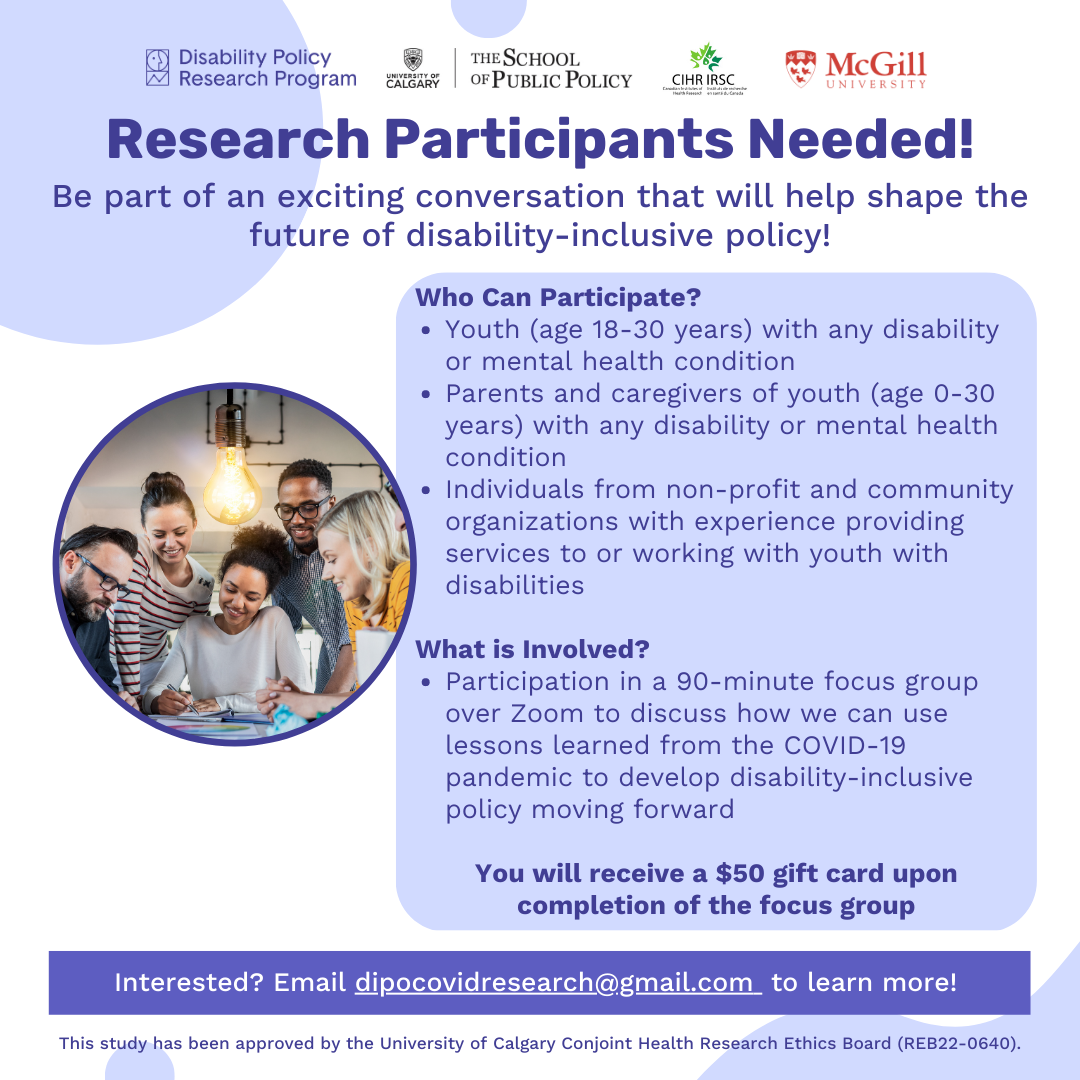
The Future of Disability-Inclusive Policy Focus Groups

Researchers with the Disability Policy Research Program at the University of Calgary are recruiting for a study that is using focus groups to discuss the future of disability-inclusive policy in Canada. These focus groups will be comprised of youth with disabilities, parents/caregivers of youth with disabilities, and representatives from non-profit organizations.Participation in this study will involve attending a 90-minute focus group discussion over Zoom. Please see the study flyer.

If you are interested in participating, email lead researcher Brittany Finlay at [email protected] for more information.

Social inclusion among individuals with autism spectrum disorder: How to advance their resilience

This Dalhousie University study will explore resilience and stress experienced by families of children with autism spectrum disorder (ASD). Researchers are also interested in understanding the strategies families and children use to cope with challenges, as well as available resources and gaps in services to promote family’s resilience. Participants must be: persons living with ASD (above 15 years), a guardian/parent of a person with ASD, or a healthcare service provider of young people living with ASD. Participants will speak with a member of the research team during a 60-minute individual interview either over phone or via Skype, whichever is convenient, to share ideas and perspectives. By participating in this interview, participants will be given a gift card (e.g., Amazon, based on your choice), valued at $30.

If you are interested, contact Dr Ghanouni at [email protected].

High School Transition Study

Researchers from the University of New Brunswick are seeking parents of youth with either autism and/or an intellectual disability for an online survey on quality of life during the transition to adulthood. Currently, very little is known about the transitional period for these youth. The researchers are hoping to address this knowledge gap and provide rationale for the implementation of transition planning programs for youth with developmental disabilities in Canada.

This online survey takes 20 – 30 minutes and eligible participants will be entered to win a $25 Amazon gift card: Online Survey.

If you have any questions about this project, contact the principal investigator, Lindsey McCullough ([email protected]). 

Body Image in Adolescents with and without Autism Spectrum Disorder

Many people with autism experience feeding and eating problems (e.g., picky eating, sensitivity to food textures, eating disorders), but it is not fully understood why. Body image (how someone thinks and feels about their body) plays an important role in eating disorders. This University of Calgary study aims to understand how teenage females with autism experience body image compared to their peers without autism. We will also examine how body image impacts eating and weight-control behaviours (e.g., dieting, exercise) in teens with and without autism.

Teenage girls (aged 12-17) and a parent/guardian will be asked to complete a brief phone screening and fill out online questionnaires about their eating behaviours, thoughts, and feelings about their body. As a thank you for participating, families will be entered into a draw for 1 of 30 $40 gift cards upon completion of the study.

If you are interested in participating in the study, please contact Jessica Baraskewich at [email protected] for more information.

Group Parent Training Project

This study by University of British Columbia will investigate the association between implementation of a group parent training model of family centred positive behaviour support (FCPBS) delivered via telepractice and: (a) improvements in child behaviours that challenge and positive engagement across the day with family members; and (b) global improvements in child and family functioning. Six families of children with autism will participate. Two facilitators will conduct a 14-week group parent training workshop on universal positive behaviour supports. Parents will record data on: (a) child behaviours that challenge; and (b) child positive engagement. Parents also will complete questionnaires on global family and child functioning. See the Study Flyer for details.

If you are interested in participating the study, please contact the principal investigator, Dr. Joseph Lucyshyn at [email protected] or Erin Badduke at [email protected].